
In October 2025, I hosted a group of master's students from the Oslo School of Architecture and Design (AHO) at Cognite for a guest lecture and workshop on designing AI-augmented systems in industrial contexts.
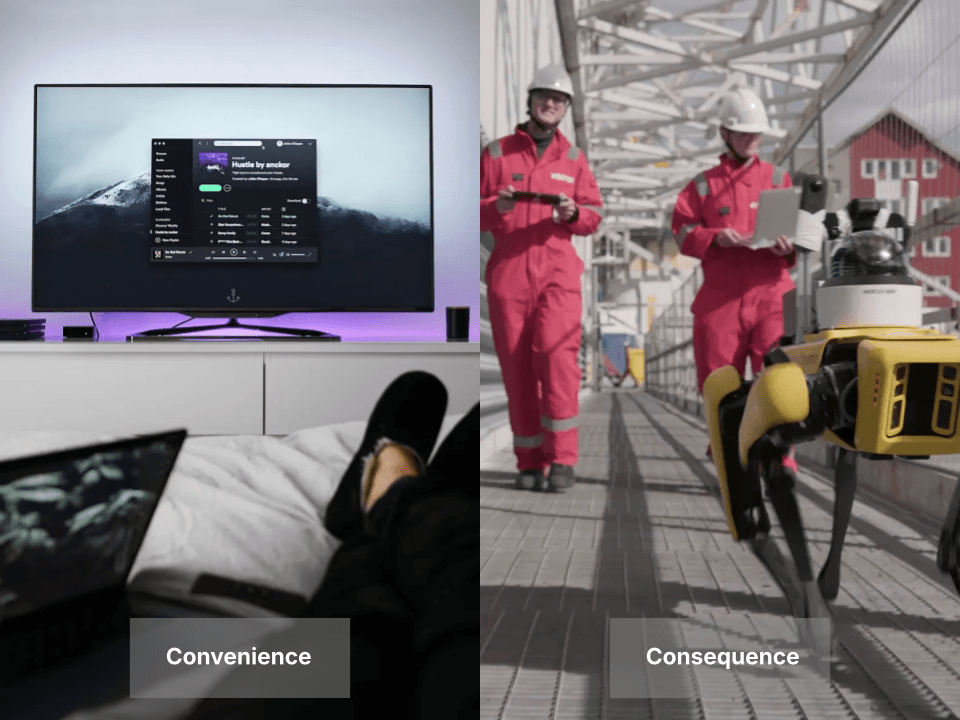
The session focused on a key distinction that is often missing from mainstream AI conversations: the difference between designing for convenience and designing for consequence.
In industrial domains, AI systems influence decisions that affect safety, production continuity, and the environment. The goal is not automation for its own sake, but supporting expert judgment with clarity, transparency, and responsibility.
Core Principles
The session was structured around three design principles drawn from real product work:
The user stays in charge
AI suggests and supports, but never makes the final call. Human judgment remains explicitly in control.
Transparency builds trust
AI systems should show their reasoning, sources, and assumptions - never operate as black boxes.
Enhance, don't overwhelm
AI should reduce cognitive load at the right moment, without hiding complexity or flattening nuance.
From Theory to Practice
Alongside real-world product examples, students worked through applied exercises including:
- Designing human-in-the-loop AI interactions
- Applying transparency patterns to conversational agents
- Exploring AI as a supporting collaborator rather than an automated decision-maker
We also discussed "personas at speed" - using AI to rapidly synthesise lightweight, working personas from existing research data to unblock early design decisions, while keeping human judgment and validation firmly in place.
.png&w=1920&q=75)
Outcome
The students quickly grasped how these principles translate into real-world design decisions and applied them naturally to complex scenarios. The session reinforced the importance of teaching AI design as a socio-technical discipline, not just a technical one.
.png&w=1920&q=75)